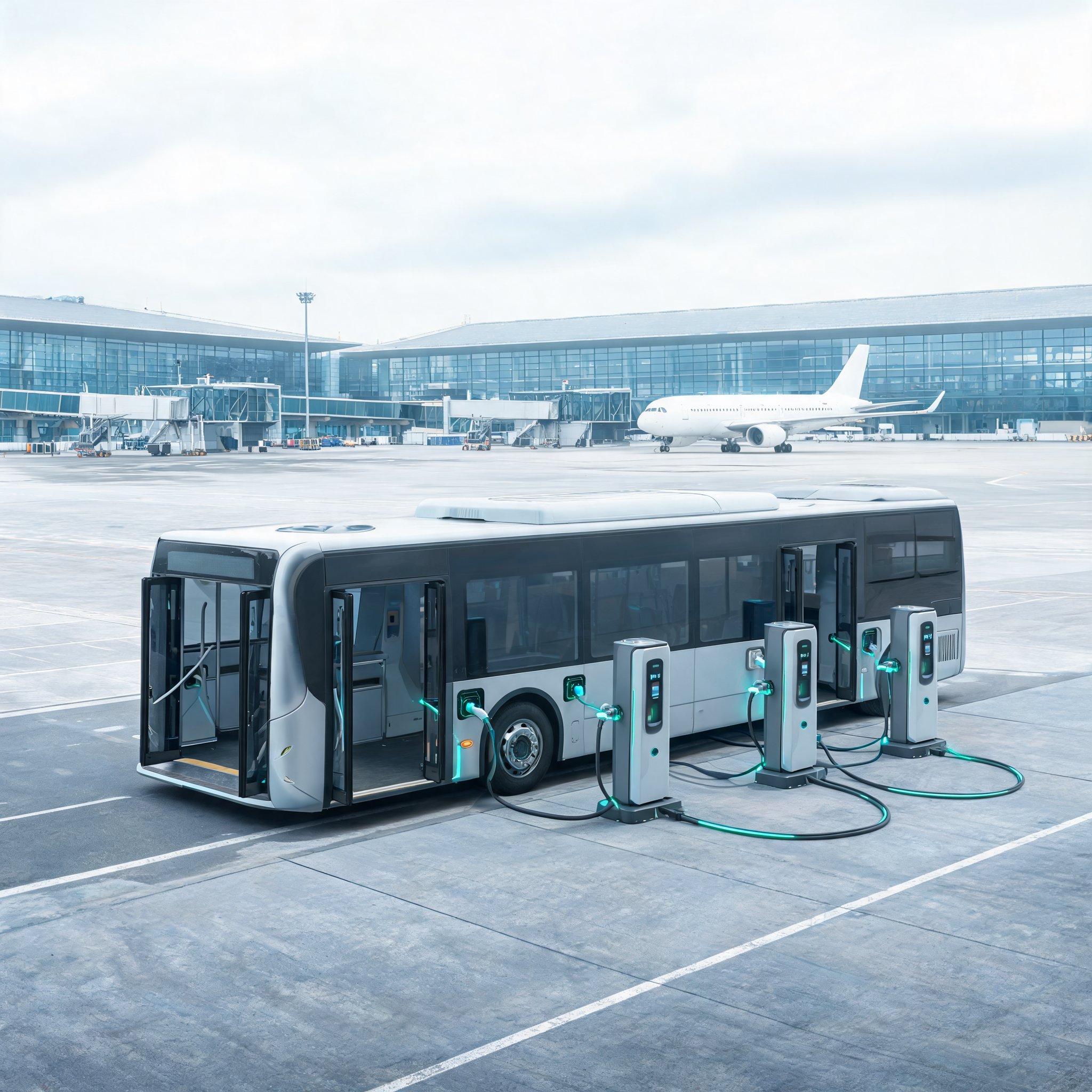
Vilnius Airport is replacing its diesel passenger-transfer buses with twelve battery-electric vehicles from Cobus. Lithuanian Airports (LTOU) unveiled the fleet and said the buses will enter service on 16 November. The investment totals €7.2 million and includes maintenance and repairs.
The buses carry passengers between the terminal and aircraft and will fully replace the airport’s previous diesel fleet. LTOU says the switch is intended to cut local emissions and noise on the apron. It estimates that replacing the diesel buses will avoid around 58 tonnes of CO2 emissions each year.
Charging and operating range
Three dual charging stations have been installed for the fleet, allowing up to six buses to charge at the same time. The electricity will come from renewable sources. According to LTOU, the buses can operate for up to three days on a single charge, depending on conditions. By contrast, the previous diesel buses could run for about twelve hours on a full tank.
According to LTOU, the extended operating range will give the airport more flexibility in planning vehicle rotations and charging schedules. The airport says this is particularly intended to simplify the organisation of passenger transfers while airport operations continue.
Airport-specific design
The Cobus buses were designed specifically for airport use and can carry up to 100 passengers each. Wide doors on both sides and a lowered entrance are intended to speed boarding and alighting and to improve access for passengers with luggage, prams or reduced mobility. The vehicles also have automatic climate control. Because they use electric drivetrains, they are significantly quieter than the diesel models they replace.
Service and strategy
Cobus will remain responsible for the vehicles after they enter service. A five-year contract covers maintenance, repairs and spare-parts supply, as well as remote monitoring of vehicle condition and 24/7 technical support.
The bus electrification is part of LTOU’s broader net-zero strategy. The company aims to become climate-neutral by 2030 and to reduce CO2 emissions from airport-controlled operations to zero by 2040.
Electrification efforts in Vilnius extend beyond the airport. In May, municipal transport operator VVT ordered 112 all-electric MAN Lion’s City E buses, including 84 solo and 28 articulated vehicles. Lithuania is also using EU funds to support electric bus fleet expansion, and since 2026 transport operators in the country have been required to procure only buses with alternative drivetrains.
From 16 November, LTOU will also take over passenger transport at Vilnius Airport itself. A dedicated unit with 35 drivers has been established for the operation.