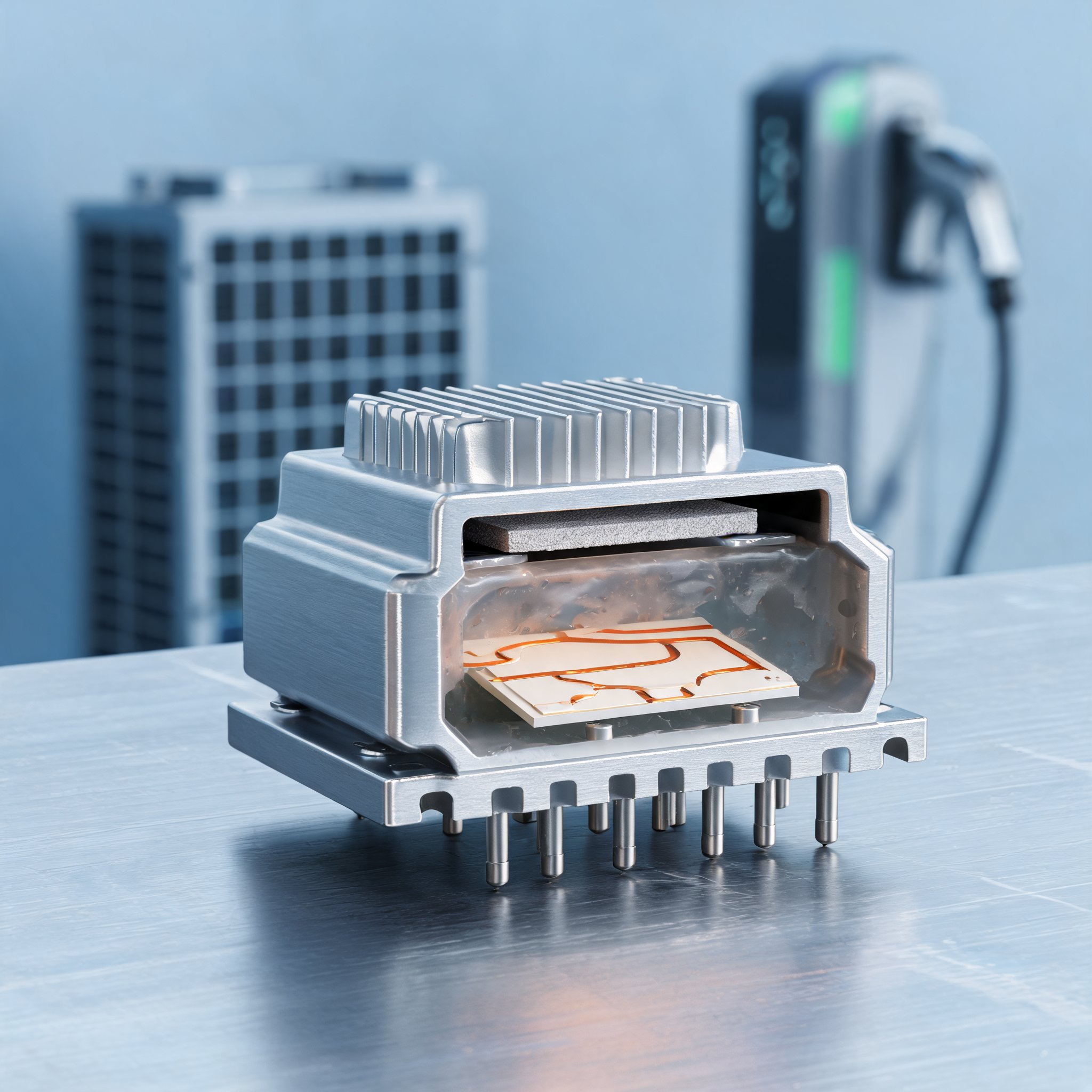
Navitas Semiconductor has introduced the G4H08MT23GB4 family of 2,300 V full-bridge silicon carbide (SiC) power modules. The company says the devices are designed to improve efficiency and power density in solid-state transformers, grid-scale battery storage, solar inverters and electric vehicle megawatt charging infrastructure.
The family uses the SiCPAK form factor and has an on-resistance of 8 mΩ. It is based on Navitas’s fourth-generation GeneSiC Trench-Assisted Planar architecture and extends the company’s portfolio of 2,300 V and 3,300 V ultra-high-voltage SiC devices. The new parts are full-bridge modules, and Navitas is positioning them for the power-conversion systems listed above.
Packaging for isolation and thermal performance
Navitas uses an aluminum nitride active-metal-braze substrate to provide heat spreading and support isolation of more than 5 kV. The modules are potted with an epoxy resin formulated to reduce internal stress and limit the ingress of moisture and contaminants. According to Navitas, the potting has 10 times the thermal conductivity of silicone gel.
Optional high-current press-fit pins are available with twice the current-carrying capability per pin of standard press-fit connections, according to the company. An optional pre-applied thermal interface material (TIM) is intended to simplify and standardize heatsink assembly. The pin and TIM choices are optional: samples can be ordered with or without the pre-applied TIM, and with standard or high-current pins.
AEC-Plus qualification
The family will be qualified to AEC-Plus, an internal reliability benchmark that Navitas says goes beyond AEC-Q101 and JEDEC requirements. AEC-Plus includes dynamic reverse bias and dynamic gate switching tests intended to represent fast-switching mission profiles. It also more than triples the duration of static high-temperature, high-voltage tests and adds extended power-cycling and temperature-cycling testing.
Because AEC-Plus is described as an internal benchmark, the qualification claim is distinct from the external AEC-Q101 and JEDEC requirements cited by Navitas. The added tests are intended to cover fast switching and extended operating stress, according to the company’s description of the benchmark.
Samples and evaluation options
Samples are available in four versions. Customers can choose modules with or without the pre-applied TIM and with standard or high-current pins. For evaluation, Navitas offers the EVB-UHVSIC-GB-E-DPT-1 double-pulse test system on request; the board is intended to help engineers assess switching performance.
Company positioning
Paul Wheeler, vice president and general manager of Navitas’s SiC Business Unit, said the fourth-generation GeneSiC Trench-Assisted Planar architecture continues to push the limits of ultra-high-voltage SiC. According to Wheeler, the new 2,300 V module delivers a leading on-resistance among devices using the SiCPAK form factor and provides system designers with a reliability-tested building block for solid-state transformers and energy storage systems that he said are reshaping grid and AI data center infrastructure.
Wheeler’s comments link the module to solid-state transformers, energy storage and AI data center infrastructure, while the product announcement also lists solar inverters and EV megawatt charging among the target applications.