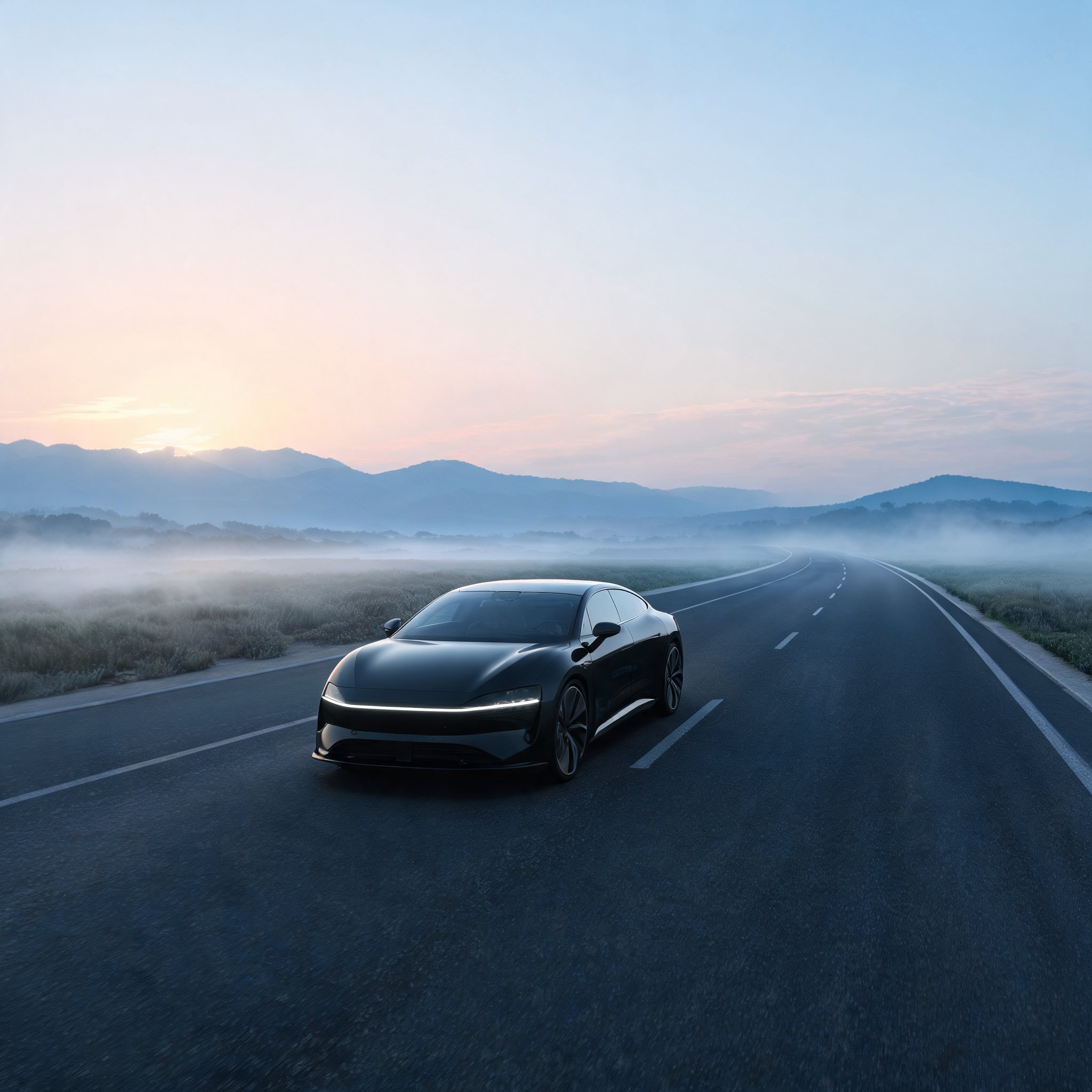
The Lucid Air Grand Touring carries a demanding dual brief: it must show that a relatively young American manufacturer can rival established luxury brands, and it must justify a test-car price of €144,500. In a two-week test on motorway, city and country roads, it delivered genuine strengths in range, efficiency, quietness and packaging. It also revealed details that are difficult to excuse at this price.
That mixed outcome matters because Lucid is in restructuring. New CEO Silvio Napoli calls it an operational restart. The company aims to save $1.4 billion this year, has cut around 18 per cent of its workforce and has postponed more affordable mid-range models to the second half of 2027. It delivered 3,806 vehicles in the third quarter. Until the mid-range platform arrives, the Air and the Gravity SUV must carry the business, while a planned European robotaxi service with Bolt is also to use that future platform.
Packaging and aerodynamics
At 4.97 metres long, 1.41 metres tall and 1.94 metres wide, with a 2.96-metre wheelbase, the Air is smaller than a Mercedes EQS or BMW i7. Its flat, elongated front, forward windscreen and short, arcing rear are clearly shaped by aerodynamics. On 19-inch wheels, Lucid quotes a drag coefficient of 0.197. That matters because air resistance dominates energy use at higher motorway speeds, so aerodynamic gains translate directly into range.
The packaging is unusual. Lucid's motor, inverter and transmission unit weighs 74 kg, leaving room for a 283-litre front boot. The frunk opens and closes electrically by key fob, display or app, a practical feature when carrying shopping. The rear boot holds 627 litres; total capacity is 910 litres with the frunk, 1,835 litres with the rear seats folded including the frunk, or about 1,552 litres folded without it. The notchback body means a smaller boot opening than a hatchback.
Interface with clear strengths and avoidable gaps
Inside, a 34-inch curved Glass Cockpit spans the dashboard, with a centre-console Pilot Panel for climate, seats and vehicle settings. The panel rises electrically to reveal storage. The menu is intuitive, and navigation calculates reliably, plans charging stops automatically and filters by charging power and operator. Those are meaningful advantages on long journeys.
Smartphone integration is restricted. Apple CarPlay and Android Auto run only in the smaller right-hand section of the Glass Cockpit, not on the Pilot Panel or driver display. Lucid has acknowledged this and has been rolling out Air UX 3.0 since late September for model year 2025 cars; the update should let both systems use the entire right half of the cockpit display, but the test could not verify it. A head-up display is not even optional, despite being offered by main competitors. The steering-wheel rotary controls feel harsh, the key is cumbersome, and DreamDrive Premium lacks the LiDAR and hardware needed for future hands-free driving; that requires the €4,200 Pro package, with no retrofit possible.
Powertrain, ride and long-distance behaviour
Two permanently excited synchronous motors, one per axle, produce 611 kW and 1,200 Nm through a fixed 7:1 ratio. The Air Grand Touring reaches 100 km/h in 3.2 seconds and tops out at 270 km/h. Smooth, Swift and Sprint modes alter throttle response, with Sprint delivering force that feels improbable in a saloon of this size. Regenerative braking is well calibrated, strong enough for one-pedal city driving.
The suspension is not air-based, as the first kilometres might suggest. It uses double wishbones at the front and a multi-link rear axle, with steel springs and adaptive dampers controlling rebound and compression separately 500 times per second. The result is excellent: cross joints, manhole covers and poor country roads are absorbed while the body stays calm, and the car remains stable at high speed. It is not a corner-carver. At 2,435 kg under the EU norm with driver, and nearly five metres long, it feels its mass in fast bends. There is no rear-wheel steering and the turning circle is 12 metres.
Range and charging define the case
The Air Grand Touring has a 117 kWh net battery and a 900-volt architecture. Lucid quotes 960 km WLTP with 19-inch wheels; the test car's computer showed 935 km when full. Consumption ranged from 14–15 kWh/100 km in economical city driving to 19–23 kWh in mixed use and 22–25 kWh on the motorway at and above the limit. A brisk 500-km run recorded 25.8 kWh/100 km. Calculated theoretical ranges are about 780–835 km in the city, 510–615 km mixed and 470–555 km at high motorway speeds.
External tests add context. In the NAF winter test in January 2026, the Air managed 520 km at temperatures down to -31°C, almost 100 km more than the second-placed car. In July 2025, an Air Grand Touring covered 1,205 km without charging through the Alps, from St. Moritz to Munich, with long downhill sections. At a DC charger, Lucid claims up to 300 kW and about 400 km in roughly 16 minutes. The test took about 28 minutes from 10 to 80 per cent state of charge and peaked at 305 kW. AC charging is 22 kW as standard, giving a full charge in just over six hours, and the onboard charger is bidirectional. North American 2026 models are compatible with Tesla Superchargers; in Europe, CCS access covers common fast chargers, while older 400-volt stations require a converter and charge more slowly.
Competitive position and verdict
The Air's closest rivals highlight both its lead and its gaps. The Mercedes EQS 580 4MATIC starts at €134,732, produces 430 kW, has a 122 kWh battery, up to 869 km WLTP and 350 kW charging. It is longer, has a 610-litre boot and no frunk, but offers a head-up display, optional rear-wheel steering and 1,700 kg towing. The BMW i7 60 xDrive costs €140,100, is 5.40 metres long, produces 400 kW, reaches 100 km/h in 4.8 seconds, has a 112.5 kWh battery, 727 km WLTP, a 400-volt architecture and 250 kW charging; it prioritises rear-seat comfort. The Volvo ES90 Twin Motor Performance is far cheaper at €94,490, with 500 kW, 350 kW charging, 686 km WLTP, a 102 kWh battery, a 446-litre boot, a 22-litre frunk, a large tailgate and 2,000 kg towing, but a 180 km/h limit.
The Lucid's advantages are performance, space, efficiency and weight. It is the lightest here at 2,435 kg EU. Competitors answer with head-up displays, rear-wheel steering, tow hitches and denser dealer networks. Lucid is expanding in Germany through studios and retail and service partners, but its network remains thinner than Mercedes or BMW. A certified used programme, with cars up to five years old, under 100,000 km, a 163-point inspection and at least one year of warranty, offers a lower entry point; used Air Pure models start around €77,087.
The verdict is specific rather than universal. The Air Grand Touring is one of the best long-distance electric cars available, with excellent suspension, an exceptionally quiet cabin, an immense but understated powertrain, reliable charging planning and storage that beats its rivals. Its weaknesses are detail-level and more irritating because of the price: no head-up display, constrained phone integration, harsh controls and a cumbersome key. It suits drivers who want an elegant electric travel car, do not need to tow and can accept a sparse service network. Lucid's restructuring remains a risk to watch, but the car demonstrates real technical capability; the next task is polishing the details.