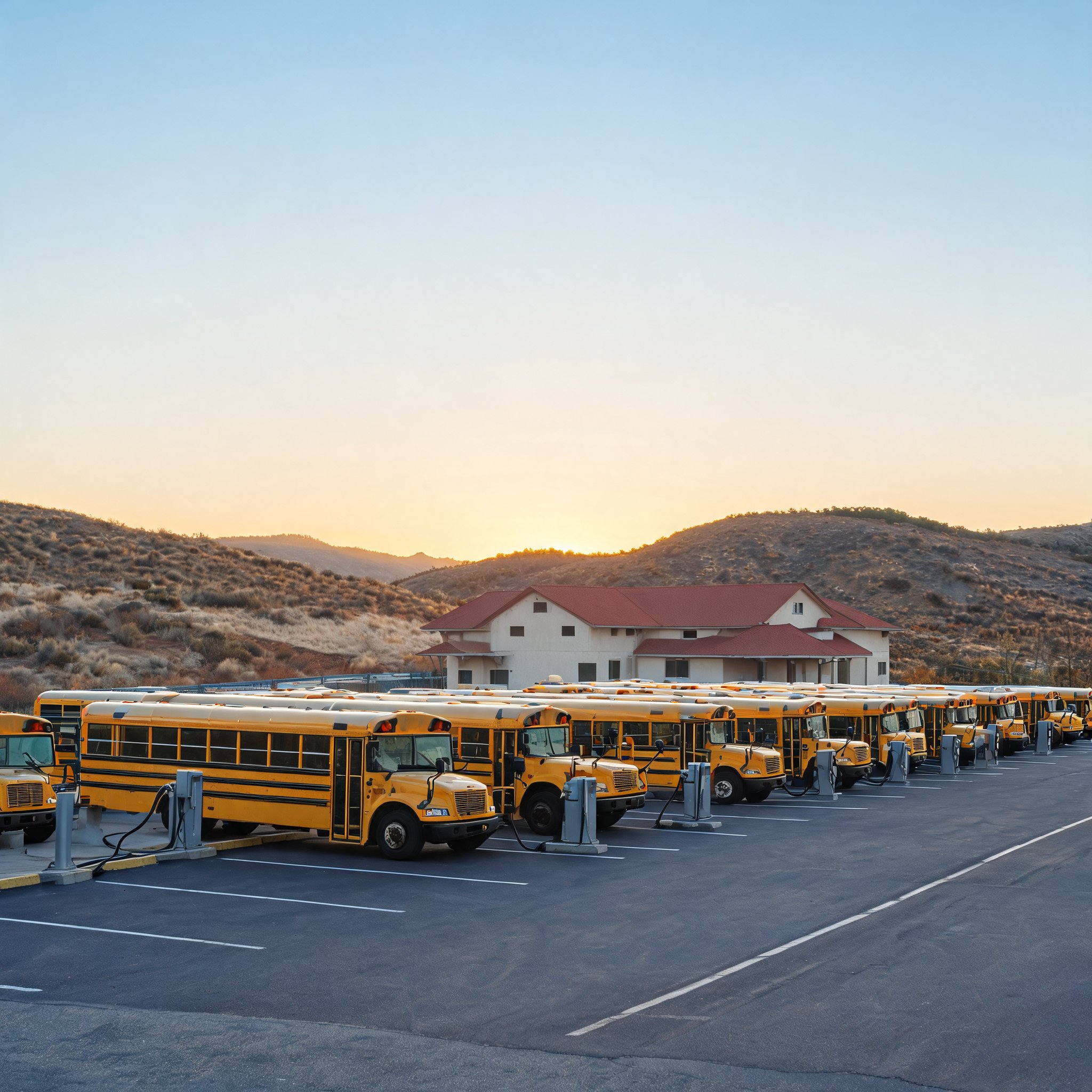
California has reopened its Zero-Emission School Bus and Infrastructure (ZESBI) incentive programme, with at least $55 million in state funding available to help school districts buy electric school buses and install charging infrastructure.
The second ZESBI funding round combines vehicle and charging-equipment incentives in one application. Funding will go to eligible local educational agencies on a first-come, first-served basis. The California Air Resources Board and the California Energy Commission jointly fund the programme, while Catalyst Mobility, formerly CALSTART, administers the grants.
Application window and charger rule
A pre-application period opened on 3 November, allowing applicants to create accounts and prepare documents. Formal applications will be accepted from 17 November at 10:00 Pacific Time. Each application must request at least one charger for every electric school bus included, linking vehicle support directly to charging deployment.
Additional support and eligible costs
Successful recipients can receive up to an additional $40,000 per approved bus. The supplementary funding is intended to help offset higher procurement costs after the elimination of the US federal Commercial Clean Vehicle Credit (45W), as well as price increases caused by federal tariffs.
Up to 10 percent of each grant award may go to wider school transportation programme costs. Eligible expenses include workforce training, technical assistance, repairs to buses and chargers, workshop equipment and improvements to transport yards. These categories extend the grant beyond vehicle and charger purchases to operational readiness and depot upgrades.
Rachel Chard, senior director of bus programs at Catalyst Mobility, said the new ZESBI round and the extra $40,000 funding opportunity reinforce the partnership's lasting commitment to delivering clean transportation technologies to communities disproportionately affected by poor air quality.
Earlier funding
California first launched ZESBI in 2024 with a $500 million funding round supporting the replacement of around 1,000 school buses. In April 2025, the state announced that 133 educational agencies had been selected for grants under that initial round. Those awards included up to $375,000 to replace an existing bus, along with funding for charging infrastructure.
The reopened round pairs bus purchases with charging requirements and adds per-bus support tied to current cost pressures. Because awards are allocated on a first-come, first-served basis, the timing of eligible applications will determine which agencies receive funding.