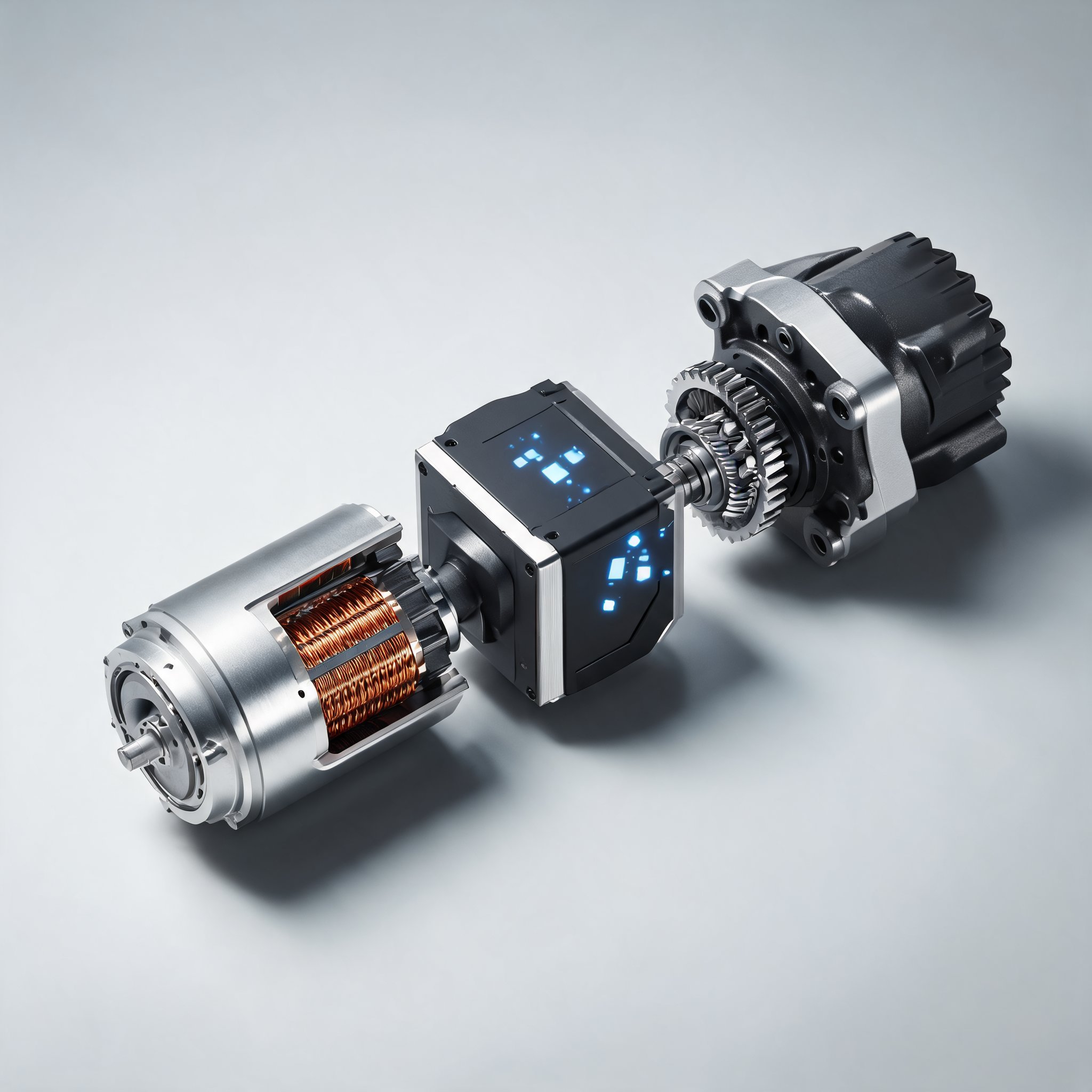
Audi has upgraded the electric drive used in its new A2 e-tron compact EV, adopting silicon carbide (SiC) MOSFETs in the pulse inverter and revising the motor and transmission to reduce energy consumption and improve acoustic comfort. The unit is the Volkswagen Group's APP350, a permanent-magnet synchronous motor mounted parallel to the rear axle.
The APP350 operates at 400 V and delivers up to 350 Nm of torque. Audi uses it in the A2 e-tron at three performance levels: 125 kW, 140 kW and 170 kW. Audi says the A2 e-tron is its most efficient model to date; the 140 kW version with the optional efficiency package has a preliminary combined WLTP consumption figure of 12.8 kWh/100 km.
SiC inverter and adaptive switching
The new pulse inverter replaces the silicon-based bipolar transistors used previously with SiC MOSFETs. According to Audi, these devices reduce switching losses and enable efficiencies above 97%. A new software function takes advantage of the SiC MOSFETs' higher switching speed to adjust the switching frequency to the operating point, because a lower switching frequency means fewer losses. The adaptive strategy is intended to make the most of lower switching frequencies in city traffic and on rural roads, where medium speed and load conditions prevail.
For acoustic comfort, the inverter also superimposes high-frequency harmonic components on the motor current to compensate for noise. This is a control-based measure rather than a change to the motor's basic topology.
Motor changes target iron and partial-load losses
The rotor laminations are more than 30% thinner than those in the predecessor MEB drive, the APP310, a change aimed at reducing iron losses. Audi also staggers the rotor segments instead of arranging them linearly; it says this almost eliminates dominant tonal components when the vehicle pulls away from a standstill. In the stator, Audi switches the winding from a star to a delta configuration and reduces the number of parallel branches. These measures are designed to increase efficiency under partial load.
Transmission ratios and lubrication
The transmission uses a 10.21:1 gear ratio in the 125 kW and 140 kW versions and an 11.53:1 ratio in the 170 kW version. Each ratio is selected so that the motor operates in the most efficient ranges of its characteristic map. Fine machining produces smooth tooth flanks that reduce friction losses and allow the use of a low-viscosity transmission oil. The low-viscosity oil and revised oil routing are designed to reduce churning losses in the gear set.
Together, the changes affect the inverter, rotor, stator and transmission. Audi presents the package as a way to lower energy consumption and improve acoustic behavior in the A2 e-tron, while retaining the APP350's 400 V architecture, rear-axle-parallel layout and three output levels. The consumption figure cited for the 140 kW version is preliminary and based on the WLTP combined cycle; Audi's efficiency and acoustic claims are company statements about the upgraded drive unit.