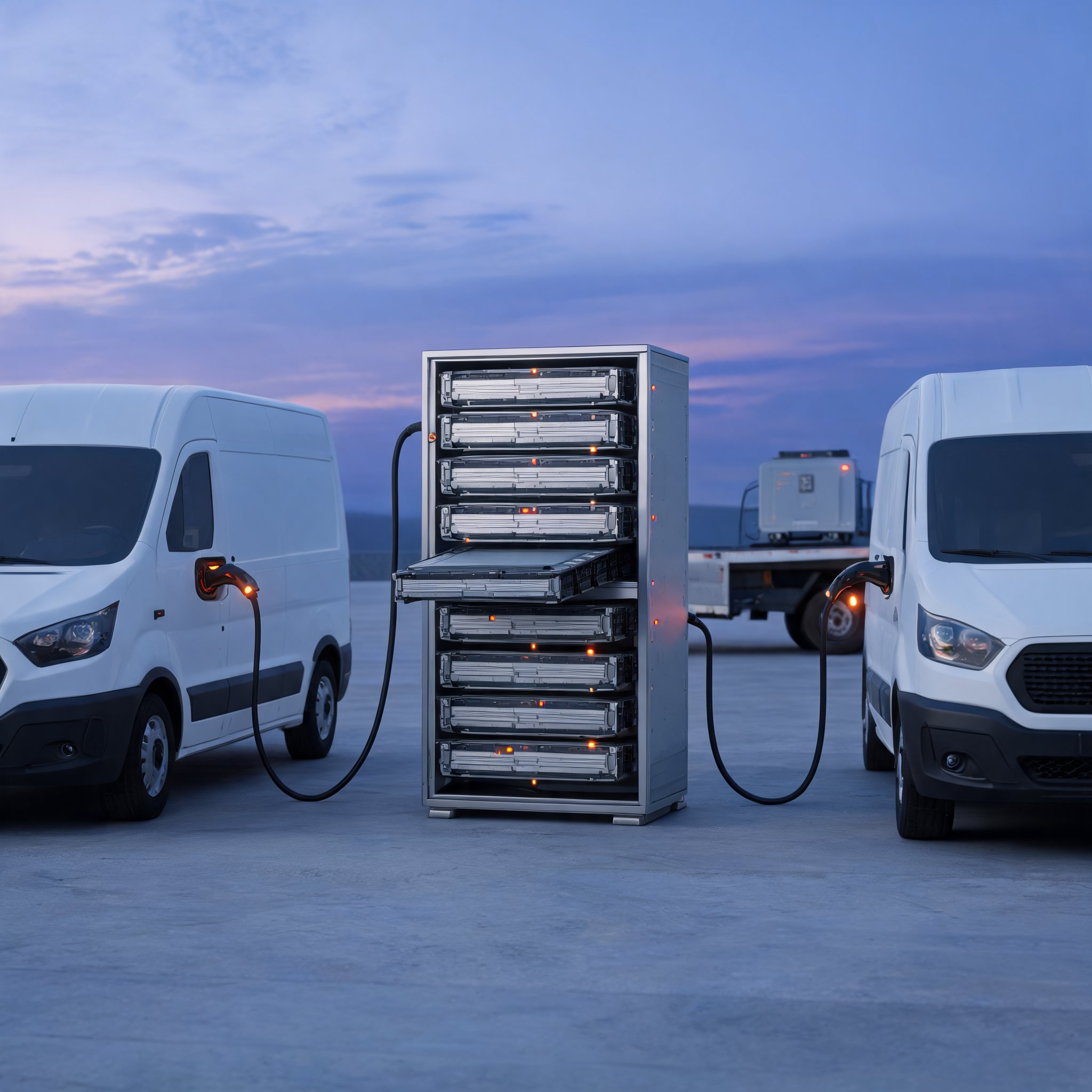
Allye Energy has introduced the MEV, a battery-buffered electric vehicle charger that uses complete repurposed EV battery packs to deliver high-power charging where grid capacity is limited. According to the UK company, the MEV can draw power from whatever electrical supply a depot already has and release it to two vehicles at once at up to 400 kW, including from a 16 A connection.
The MEV sits alongside Allye's MAX300, a trailer-mounted battery energy storage system and DC charger that the company compares to a fuel tanker. MAX300 can be towed by a van or pickup and used for portable charging at up to 400 kW or to add storage to a fixed charging site. Allye describes the MEV as a fuel pump with its own tank underneath, designed for sites where the charger stays in place.
Two MEV variants
Allye has launched the MEV in two configurations. The MEV200 combines 155 kWh of storage with charging power up to 200 kW, while the MEV300 offers 232 kWh and up to 300 kW. Both can operate from a 16 A single-phase supply up to a 125 A three-phase supply. The company says some fleets may use both products, starting with an MEV and adding a MAX300 when more capacity is needed.
Founder and CEO Jonathan Carrier said the two lines are separate ranges rather than variants of one product. In his description, a charger that remains in place and only charges vehicles is handled by the MEV on the supply already available, often for less than the connection work it would replace. When energy must move, towed behind a van or used to feed a row of chargers, the MAX300 is the intended product.
Pack controls and voltage architecture
The MEV is engineered and built in the UK using batteries from UK-registered vehicles and 95% British-sourced components, according to Allye. The company's PackFlex technology gives each pack independent battery management and power control, allowing packs of different sizes, ages and chemistries to share a cabinet. An 800 V architecture is intended to maximize efficiency and power and to serve both 400 V and 800 V vehicles.
CTO Robert Carter said the MEV grew directly out of the MAX300 program. He identified the main engineering challenge as making packs of different sizes and ages operate as one system and deliver up to 400 kW of DC charging through an 800 V architecture and Allye's in-house technology stack. Once that was solved, he said, the MEV followed as the same architecture in a charging-only cabinet, with one pack able to slide out for service while the others continue charging.
Deployments, emissions claim and timing
Allye says reusing EV packs avoids an estimated 15 to 24 tons of CO2 per MEV compared with using new cells. More than 20 MAX systems, built from over 100 repurposed batteries, are currently in service with customers including JLR and Roadchef, according to the company. At Roadchef's Killington Lake services on the M6, a MAX300 has operated for more than two years on a fixed 315 A supply shared by shops, a hotel and EV chargers. MAX500 units are charging electric excavators for National Highways on the Lower Thames Crossing.
Allye expects MEV deliveries to begin in the second quarter of 2027, in time for Round 2 of the UK government's Depot Charging Scheme. The company also offers charging-as-a-service, covering work from site survey through commissioning.