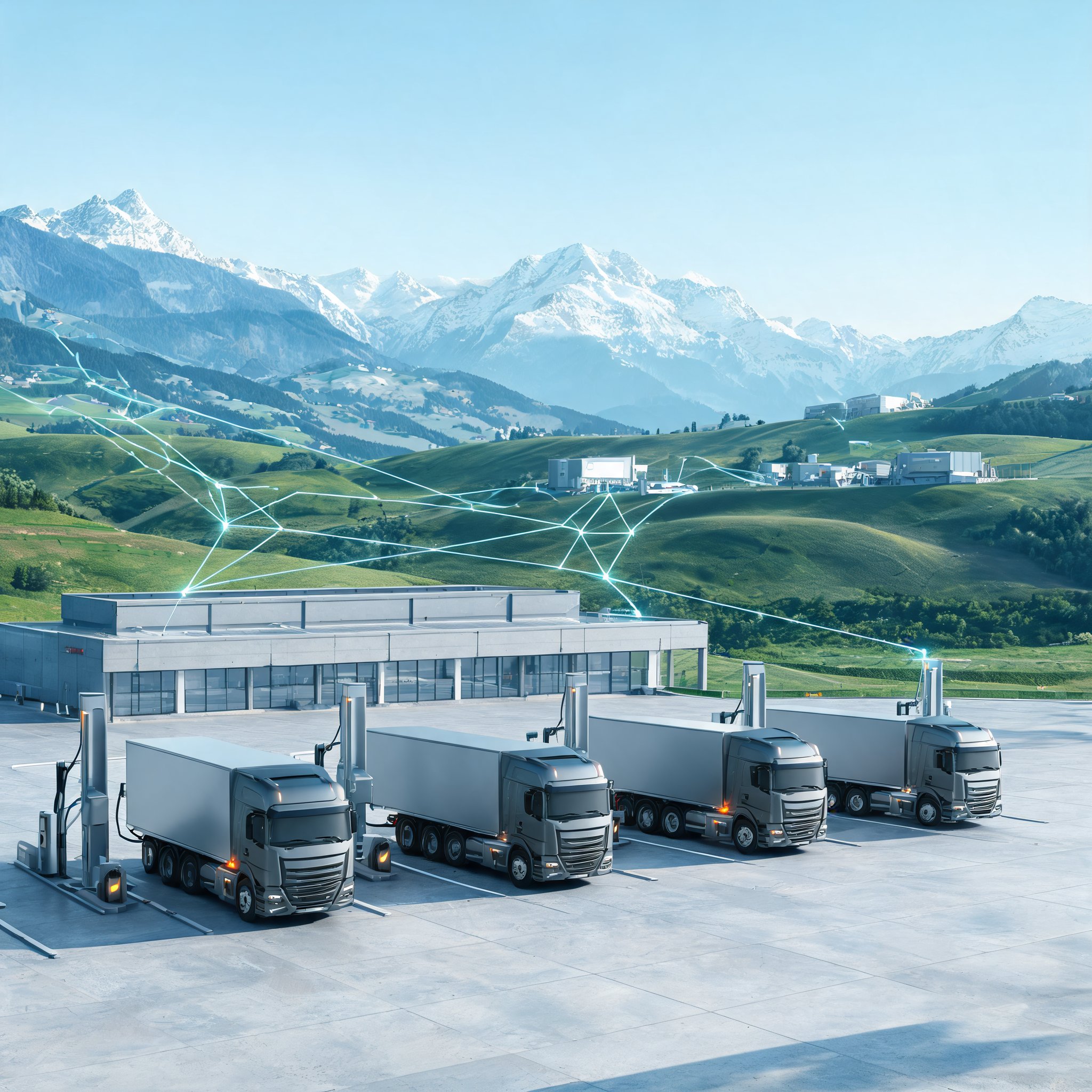
The Swiss Commercial Vehicle Association ASTAG has launched ASTAG Charge, a network that allows member companies to share truck charging infrastructure. At launch, 100 companies are participating with 585 electric trucks, around 200 charging points and 60 locations.
The network combines two earlier Swiss initiatives, Utopia and ASTAG Charge, both built on the Depotcharge platform developed by Munich-based Evolve Energy. The project began with seven companies before participation grew rapidly. Franco Digirolamo, a member of ASTAG's executive board, described the approach as connecting existing member infrastructure rather than requiring every company to build its own charging network.
According to ASTAG, the platform was designed by members for members and is intended to be simple, efficient and transparent. It draws on the association's dense network of companies and operating sites: each additional location adds charging opportunities, while each additional fleet can increase use of the network.
Member access and charging costs
Participation is open only to association members. Companies register on astag-charge.ch, and fleet operators can then use available charging options. Site operators that want to provide charging infrastructure can have their location connected to the platform. Joscha Specks of technology partner Depotcharge said the connection can often be completed within a few working days and sometimes remotely.
Organisers say participants pay no setup or basic fees. Costs arise only when charging takes place, with sessions and billing handled digitally through the platform. The earlier Utopia project involved Swiss energy company Repower and logistics specialists DPD and G. Leclerc Transport in an open rollout, while ASTAG ran a closed network for its members. The technical merger of the two initiatives is scheduled for 1 December.
Swiss electric truck context
The Swiss launch forms part of the Electromobility 2030 roadmap of the Swiss Federal Office of Energy. Truck fleet electrification in Switzerland is advancing faster than in the rest of Europe. ACEA statistics cited in the article show 605 new registrations of electric trucks weighing more than 16 tonnes in the first nine months of the year, up 62 per cent year on year. Electric models accounted for 24 per cent of registrations in that weight class, placing Switzerland at the top of the European market.
At the same time, newly emerging charging infrastructure often remains underutilised, while fleet operators charging at public stations usually pay significantly more than at depots. Depotcharge is intended to bridge that gap by connecting site operators with available charging capacity to fleet operators that need cost-effective charging away from their own depots.
Under the model, companies can share charging points and make underused slots available to other registered fleet operators. Those operators enter usage agreements with site operators, book the desired time windows and gain access to the charging points. Site operators set access times and prices individually, while Depotcharge handles access management, reservations and automated billing.
Scale and stated potential
ASTAG says it represents 3,700 members and partner organisations operating a total of 30,000 commercial vehicles in goods and passenger transport, so the 100 launch participants represent a small share of the association's reach. The association says the sharing system could allow site operators to generate 50 per cent additional revenue by monetising unused charging capacity, and could save fleet operators 50 per cent compared with public charging infrastructure. These are stated potentials rather than verified results.
The launch shows how an industry association can pool depot charging capacity instead of relying solely on public infrastructure. Its impact will depend on how many members connect sites, how access and pricing are handled, and whether the network can add locations and fleets while keeping charging convenient for drivers.